Someone Has to Ask About the Truck. That's the Upfitter's Job.
On a drone program, everyone in the room knows the aircraft but not the vehicle. As the upfitter, our job is to ask the questions nobody else will — before it's too late to change the answer.
Someone Has to Ask About the Truck. That’s the Upfitter’s Job.
Why the aircraft is the easy half to admire — and what it actually takes to build the vehicle that makes a drone mission work
Published by Fengqi Automobile · 6 min read · Published September 2026
The room where nobody knows the truck
On a drone job, everyone in the room knows something we don’t.
The aircraft people know the aircraft — better than us, always. The operator knows the mission: the ground, the weather, what the crew is doing at 2am.
We know the truck.
And we’re the ones who have to build it. Upfit integrators never get the fancy launch events. We are not the shiny part. But once the excitement fades, two questions decide whether the whole program was worth doing: does it actually work in the field, and can we realistically build it. Those are ours.
So we don’t show up to tell anyone they got it wrong. We show up with a list. We go through it together. That’s how the job moves.
The baseline nobody wrote down
There’s a rough baseline for these vehicles now. Nobody wrote it down, but it’s there.
- Seats for two or three — that’s a crew.
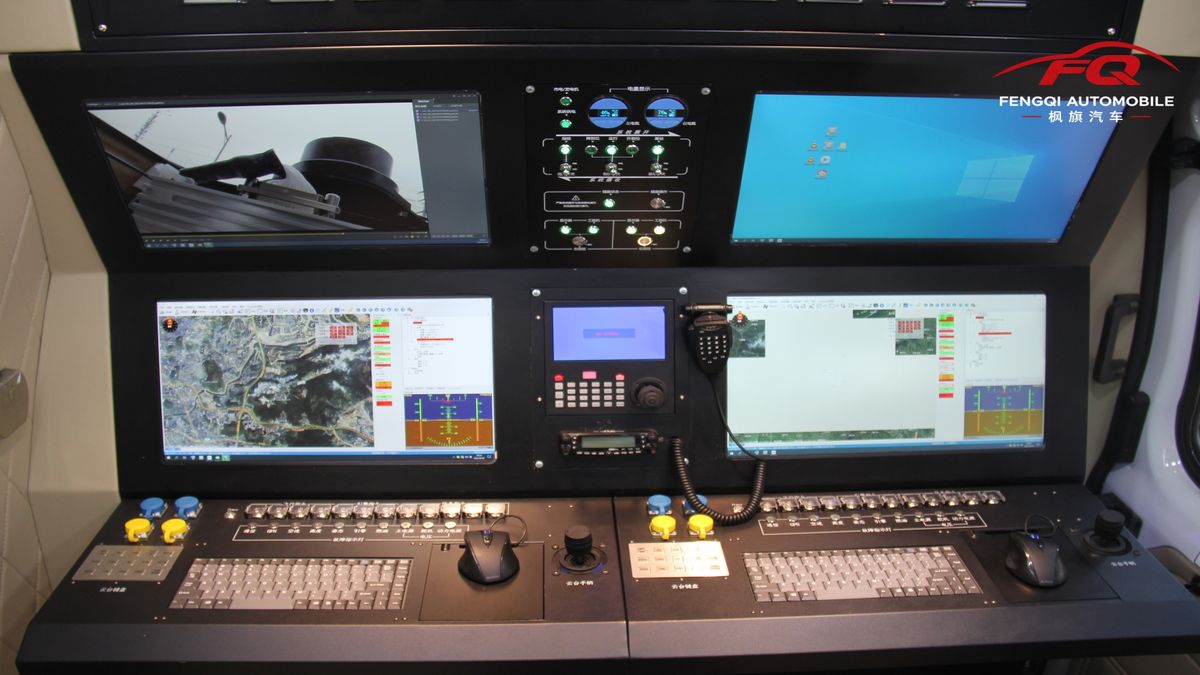
- Two control stations. One flying, one running the map or holding a backup airframe.
- Storage — mission pods, field kit, somewhere to repair or park the aircraft.
- Power for six to eight hours, at least — see the generator options.
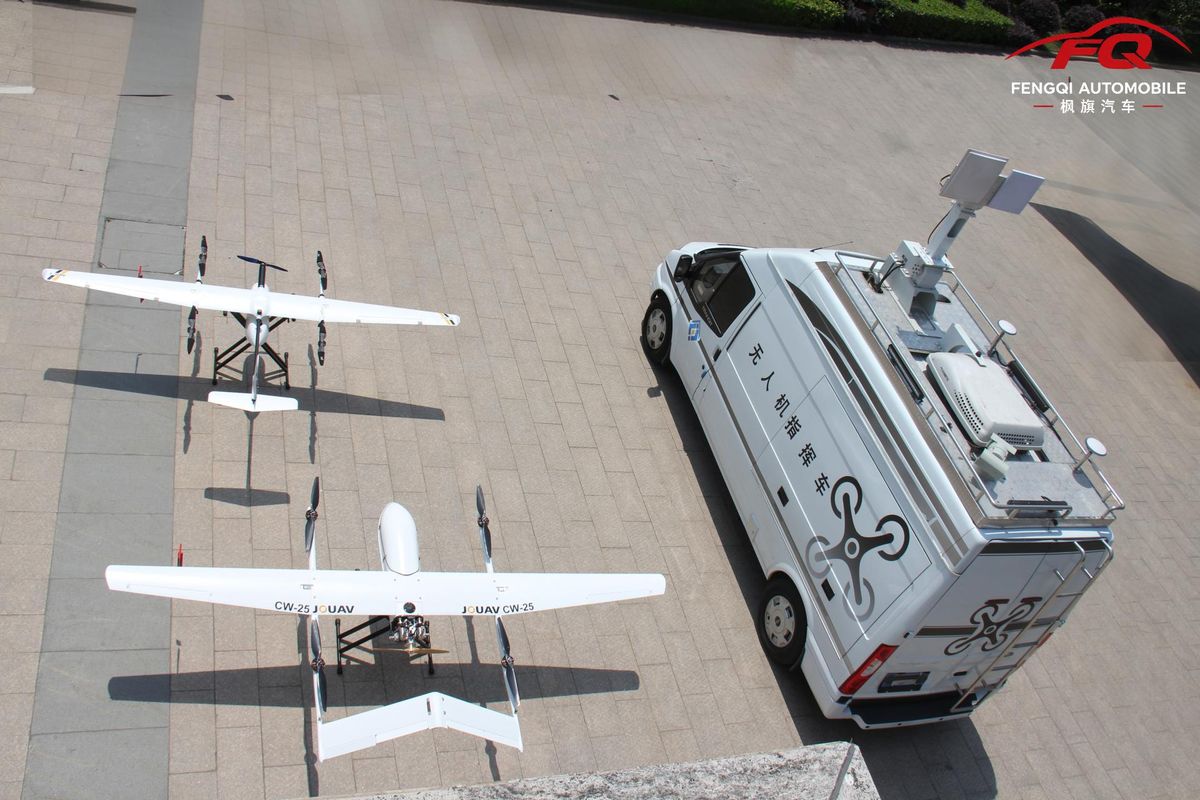
- The roof — data antennas and RTK, which need spacing or they interfere with each other, or a hatch mechanism that eats the whole roof.
- Then whatever the mission actually needs.
Nothing clever there. Just easy to miss. And once it’s on the table, people stop guessing and start designing.
Two jobs. Both anonymous.
Job one: washing solar panels from the air
A power-grid company wanted a drone and a vehicle together, to wash solar panels. The aircraft was a DJI FC200 — about 100 kg empty. What it carries is a different number, because that depends on what you hang under it.
We need both numbers. The airframe tells us how to carry and stow it. The mission module tells us what the truck has to feed it.
Looks like a clean brief on paper. Then you start asking.
How do we get it out and into the air fast? Where does the water come from, and how much — because washing eats water. There’s a high-voltage tether going out and a water hose going out. How do those two pay out and come back without wrapping around each other — high voltage next to running water? What’s the safety case? The length of that cable and hose sets the working radius, so what radius does this site need? The pump has to hit a pressure and a flow number, but every litre of tank is weight — where does the tank stop being worth it? And the water should be soft. Do we treat it on the truck, or is it treated before it reaches us?
None of that is clever. It’s just expensive to answer late. And it’s not the aircraft company’s job to ask. It’s ours.
Job two: moving 10-meter composite-wing UAVs
A drone manufacturer needed to move big composite-wing UAVs. Wingspan over 10 meters, but it comes apart. Fuselage over 6 meters. Empty weight over 500 kg. Two of them per trip if possible.
That’s not a van. That’s a transport setup with a loading system you can trust in the field.
And the question that actually decided the design: one vehicle that carries and services, or two — one to move, one to maintain?
There’s no right answer. There’s the answer that fits the mission and the budget, and the one we can actually build. So we don’t guess. Both options go on the table with the trade-offs. The client picks. Then we build it.
About DJI — this isn’t a complaint
They made heavy lift cheap. An aircraft that can carry 100 to 200 kg is a purchase order now, not a development program. Fine. Good.
The ground half didn’t get cheaper. Power. Tether. Water. Routing. Layout. None of that came down with the airframe.
And drones are splitting — small and very large, at the same time. A small inspection platform wants a light wide-body van you can park anywhere. A 500 kg composite wing wants a class-2 chassis and a real transport setup. Two completely different trucks. Both called a drone command vehicle.
The part that’s actually ours
The most important part of both those jobs is the aircraft. We don’t make it. That’s fine. That’s not our business.
What we bring is the integration — and the judgement you only get from having done it before, on someone else’s mission, in someone else’s weather, with someone else’s budget falling apart.
That’s what clients care about. In our experience it’s the first thing they ask about. Not the loud part. The part that has to work.
So that’s the job, the way we do it. Not a lecture about the aircraft. Just making sure someone asks about the truck while there’s still time to change the answer.
Somebody has to build the thing. Around here, that’s our job.
Related reading
Part of the UAV Ground Systems Series — from command vehicles to drone support trucks. For project inquiries in your region, email international@fqvehicle.com or reach us on WhatsApp: https://wa.me/8618651908345.
Planning a build?
Tell us your operational requirements — we'll come back with an engineered proposal.
WeChat QR

WhatsApp QR